
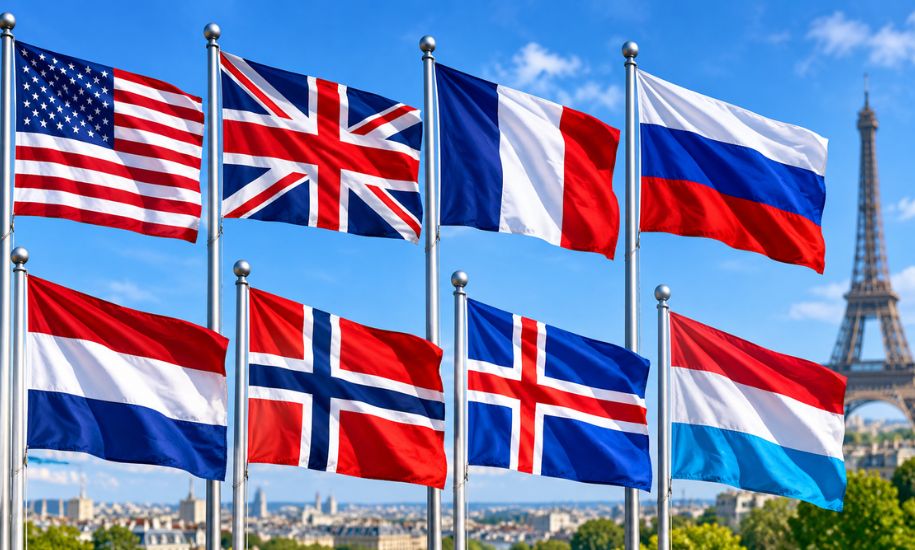
Red, white, and blue are three of the most recognizable colors in national flag design. From the familiar tricolor of France to the stars and stripes of the United States, these colors appear in flags representing different nations, cultures, and historical traditions. Although the colors may be the same, their arrangements, symbols, and meanings can vary significantly. Some countries use simple horizontal stripes, while others feature crosses, stars, triangles, or detailed emblems. Understanding these differences makes it easier to identify red, white, and blue flags and discover the stories behind them.
Red, White, and Blue Flags With Names
Several countries around the world use red, white, and blue in their national flags. The most recognizable examples include France, the Netherlands, Russia, the United States, and the United Kingdom. Each flag has a distinct design that reflects its national identity and history.
Here are some notable examples:
| Country | Flag Design | Distinctive Feature |
|---|---|---|
| France | Blue, white, and red vertical stripes | Three equal vertical bands |
| Netherlands | Red, white, and blue horizontal stripes | Simple horizontal tricolor |
| Russia | White, blue, and red horizontal stripes | White stripe at the top |
| United States | Red and white stripes with a blue canton | Fifty white stars |
| United Kingdom | Blue field with red and white crosses | Union Jack design |
| Luxembourg | Red, white, and light blue horizontal stripes | Lighter blue than the Dutch flag |
| Norway | Red field with a blue cross outlined in white | Nordic cross |
| Iceland | Blue field with a red cross outlined in white | Distinctive Nordic cross |
| Czechia | White and red horizontal sections with a blue triangle | Blue triangle at the hoist |
| Slovakia | White, blue, and red horizontal stripes | National coat of arms |
These flags demonstrate that the same three colors can create very different visual identities. The arrangement of stripes, crosses, and other symbols is often the most important factor in identifying a particular national flag.
White, Red, and Blue Flag Horizontal: Understanding Stripe Order
A white red blue flag horizontal design can be confusing because several countries use similar arrangements. The Netherlands, Russia, and Luxembourg are particularly easy to mix up.
The Dutch flag consists of three horizontal stripes arranged from top to bottom in red, white, and blue. Russia’s flag follows a different order: white, blue, and red. Luxembourg’s flag resembles the Dutch design but uses a lighter shade of blue.
The distinction becomes clearer when the flags are compared side by side.
Russian Federation flag: download the flag of Russian Federation – Country Flags
The Dutch flag has a long historical connection with the country’s maritime traditions. Russia’s tricolor became a national symbol through historical developments associated with the Russian state and its navy. Luxembourg’s flag shares a visual resemblance with the Netherlands, but its lighter blue helps distinguish it.
When identifying a horizontal tricolor, always check the order of the colors and the exact shade of blue.
Red, White, and Blue Flags With Vertical Stripes
Vertical tricolors are another important category of national flags. The French flag is one of the most famous examples, featuring three equal vertical bands of blue, white, and red.
Symboles & valeurs de la République française et de l’UE : cours
The French tricolor became a powerful symbol during the French Revolution and is closely associated with the country’s republican identity. Its design is simple, balanced, and instantly recognizable.
The correct order is blue on the left, white in the middle, and red on the right when viewed from the front. This detail is important because people sometimes mistakenly describe the French flag as red, white, and blue from left to right.
Although France is the best-known example of a vertical tricolor using these colors, its design has influenced flag traditions around the world.
Red, White, and Blue Flags in Europe
Europe contains many national flags featuring red, white, and blue. These designs reflect different historical influences, including revolutionary movements, royal traditions, national independence, and regional identity.
Some of the most recognizable European examples include France, the Netherlands, Russia, Luxembourg, Norway, Iceland, Croatia, Serbia, Slovakia, and Slovenia.
Flags of Netherlands and Russia
Norwegian and Icelandic flags. Vector.
5
The Nordic countries provide particularly interesting examples. Norway’s flag has a red background with a blue cross outlined in white. Iceland uses a blue background with a red cross outlined in white. Both designs follow the Nordic cross tradition, in which the cross is positioned toward the flagpole.
Czechia uses a different arrangement. Its flag has white and red horizontal sections with a blue triangle extending from the left side. Slovakia and Croatia use horizontal tricolors with national coats of arms, making them distinct from simpler designs.
These examples show why identifying a flag requires more than simply recognizing its colors. The position of a symbol, the direction of a stripe, and the shape of a cross can all provide important clues.
Red and Blue Flags: Countries With Additional Colors
Some red and blue flags also contain white, but their designs include additional symbols or geometric patterns.
The United States is a prominent example. Its flag features thirteen alternating red and white stripes representing the original thirteen colonies. The blue canton contains fifty white stars, representing the fifty states.
The United Kingdom’s Union Jack combines the crosses associated with England, Scotland, and Ireland. Its blue background, white diagonal elements, and red crosses create a distinctive design.
DomHarvest Export, S.R.L. — The Freshness The World Asks For
익스플레이너: 호주 국기에 담긴 의미는? | SBS Korean
4
Other examples include Cuba, whose flag features blue and white stripes with a red triangle and white star, and Australia, whose blue flag incorporates the Union Jack and stars representing the Southern Cross.
New Zealand has a similar blue background and Union Jack, but its Southern Cross is represented by four red stars with white borders. These details help distinguish the two national flags.
What Do Red, White, and Blue Mean on Flags?
The meanings of flag colors are not universal. Different countries assign their own historical, cultural, and political significance to the colors used in their national symbols.
However, certain associations appear frequently in flag symbolism.
Red is often connected with courage, sacrifice, strength, and struggles for independence. White commonly represents peace, unity, purity, or honesty. Blue is frequently associated with freedom, loyalty, justice, the sky, or the sea.
These interpretations should be understood as general associations rather than fixed meanings.
For example, the French tricolor is closely connected with the French Revolution and republican traditions. The American flag represents the country’s national identity, while its stars and stripes have specific historical meanings. The Dutch flag is associated with the country’s historical development and independence.
The symbolism behind a flag is often best understood by examining the events that influenced its creation and adoption.
How Many Countries Have Red, White, and Blue Flags?
There is no single universally accepted number of countries with red, white, and blue flags. The total depends on how national flags are classified and which countries or territories are included.
Some lists count only sovereign states whose flags contain all three colors. Others include dependent territories, regional flags, or designs containing additional colors.
For example, the United States flag includes red, white, and blue alongside a design of stars and stripes. Australia’s flag also includes the Union Jack and stars. Both qualify as red, white, and blue flags, even though their designs are more complex than a simple tricolor.
A useful way to organize these flags is by their design:
- Horizontal tricolors, such as the Netherlands and Russia.
- Vertical tricolors, such as France.
- Nordic crosses, such as Norway and Iceland.
- Flags with stars and stripes, such as the United States.
- Flags with triangles or national emblems, such as Czechia and Slovakia.
This classification helps explain why different reference websites may publish different totals.
Frequently Asked Questions
Which countries have red, white, and blue flags?
France, the Netherlands, Russia, the United States, the United Kingdom, Luxembourg, Norway, Iceland, Czechia, Croatia, Thailand, Australia, and New Zealand are among the countries that use these colors.
What country has a white, red, and blue horizontal flag?
Russia has a horizontal white, blue, and red flag. The Netherlands uses red, white, and blue, while Luxembourg uses red, white, and light blue.
Which country has a red, white, and blue vertical flag?
France is the most recognizable example. Its flag consists of three vertical bands arranged blue, white, and red.
What is the difference between the Dutch and Russian flags?
The Dutch flag has red, white, and blue horizontal stripes. Russia’s flag has white, blue, and red horizontal stripes.
Why are red, white, and blue common flag colors?
These colors have been used for historical, political, cultural, and symbolic reasons. Their popularity in national flag design is connected to influential historical flags and shared traditions.
Conclusion
Red, white, and blue flags represent a fascinating combination of national identity, history, and visual symbolism. From France’s vertical tricolor to the Netherlands’ horizontal stripes and the United States’ stars and stripes, each design has a distinctive story. Understanding stripe order, symbols, and historical influences makes it easier to identify these flags and appreciate their significance. Whether you are comparing European flags or exploring national symbols from around the world, red, white, and blue designs offer an interesting insight into the history and identity of different countries. At Brit Current, we aim to make these topics accessible through informative articles that help readers explore the world around them.

