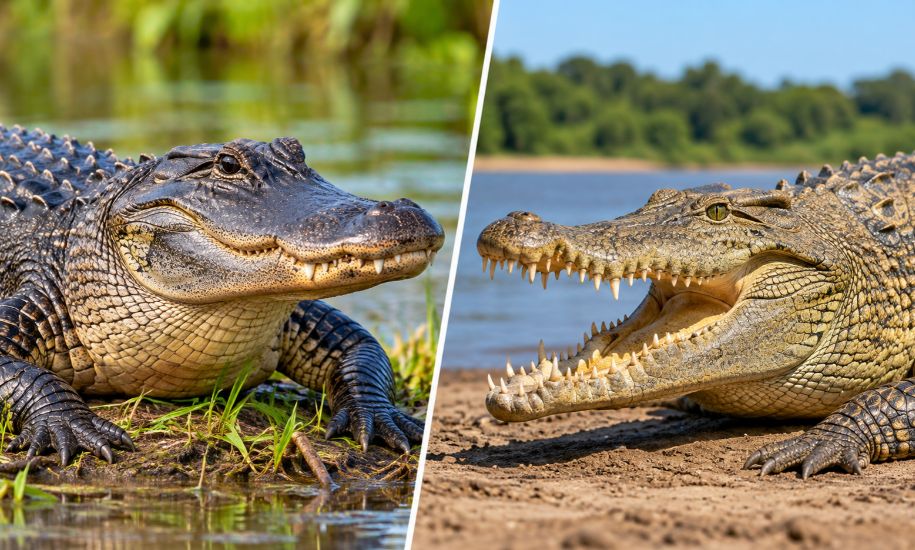
Alligators and crocodiles are two of the most recognisable reptiles in the world. With their powerful jaws, muscular tails, tough skin, and sharp teeth, they can look almost identical at first glance. However, these ancient predators have several important differences, from the shape of their snouts to their preferred habitats and behaviour. Understanding the difference between alligator and crocodile makes it easier to identify them and appreciate how each animal survives in the wild. Although both are formidable predators, their size, distribution, and potential danger to humans can vary considerably by species.
What Is the Difference Between an Alligator and a Crocodile?
The main difference between these reptiles is their physical appearance, particularly their snouts and teeth. Alligators generally have broad, rounded snouts, while crocodiles usually have longer, narrower, V-shaped snouts. Their teeth also provide a useful clue: when an alligator closes its mouth, most of its lower teeth are hidden, whereas a crocodile’s fourth lower tooth on each side often remains visible.
Both animals belong to the order Crocodylia, but they belong to different families. Alligators are members of the family Alligatoridae, while true crocodiles belong to Crocodylidae. They share many characteristics because of their evolutionary relationship, but their adaptations help them thrive in different environments.
| Feature | Alligator | Crocodile |
|---|---|---|
| Snout | Broad and rounded | Usually narrow and pointed |
| Teeth | Most lower teeth hidden when the mouth is closed | Some lower teeth remain visible |
| Colour | Often dark grey or nearly black | Frequently olive, grey, brown, or tan |
| Habitat | Primarily freshwater | Freshwater, brackish water, and sometimes saltwater |
| Distribution | Southeastern United States and eastern China | Africa, Asia, Australia, and the Americas |
| Temperament | Often less aggressive towards humans | Some species are highly aggressive and dangerous |
These are general distinctions rather than absolute rules. Species, age, and individual characteristics can influence appearance and behaviour.
Crocodile vs Alligator Size
Size is another important factor when comparing these reptiles. The American alligator is a large predator, with adult males commonly reaching approximately 11 to 14 feet in length. Females are generally smaller, although individual sizes vary.
Crocodiles also vary considerably in size depending on their species. The saltwater crocodile is the largest living crocodilian and can exceed 20 feet in exceptional cases. Large Nile crocodiles can also reach impressive lengths and possess the strength needed to capture substantial prey.
However, it would be inaccurate to claim that every crocodile is larger than every alligator. Smaller crocodile species may be considerably shorter than a large American alligator.
The crocodile vs alligator size comparison therefore depends on which species are being considered. When comparing the largest examples, saltwater crocodiles have the advantage in overall length and mass.
Difference Between Alligator and Crocodile Snout and Teeth
The snout is usually the easiest feature to examine when identifying these animals. An alligator’s broad, U-shaped snout is well suited to capturing a varied diet, including fish, turtles, birds, and mammals. Its rounded appearance makes the head look wider and heavier.
A crocodile’s snout is generally more pointed, although its shape varies between species. Some crocodiles have relatively broad snouts, so shape alone should not be treated as definitive proof.
Teeth provide another helpful distinction. An alligator’s upper jaw is wider than its lower jaw, meaning that the upper teeth cover most of the lower teeth when the mouth closes. In crocodiles, the upper and lower jaws are more similar in width, allowing several lower teeth to remain visible.
Both reptiles have powerful jaws and sharp, conical teeth designed for gripping prey. They also continually replace their teeth throughout their lives, helping them maintain an effective hunting apparatus.
Difference Between Alligator and Crocodile Water Habitats
Water preference is one of the most significant ecological differences between the two groups.
Alligators primarily inhabit freshwater environments, including rivers, lakes, ponds, marshes, and swamps. American alligators are particularly associated with the wetlands of the southeastern United States. Chinese alligators inhabit a much more restricted range in eastern China.
Crocodiles occupy a wider variety of aquatic environments. Depending on the species, they may live in freshwater rivers and lakes, coastal wetlands, mangroves, estuaries, and brackish water. Saltwater crocodiles can also travel through marine environments.
This difference is partly related to their ability to regulate salt. Crocodiles possess specialised salt-excreting glands that help them remove excess salt from their bodies. Alligators can tolerate some saltwater exposure, but they are less adapted to prolonged life in highly saline environments.
Importantly, freshwater is not exclusive to alligators. Many crocodile species live in freshwater, too, so habitat alone cannot reliably identify an animal.
Which Is More Dangerous, an Alligator or Crocodile?
Crocodiles are generally considered more dangerous to humans, particularly saltwater crocodiles and Nile crocodiles. These species can grow very large, defend their territories, and inflict fatal injuries. In regions where people regularly use rivers and coastal waters inhabited by these predators, encounters can carry serious risks.
Alligators can also be dangerous. American alligators have been responsible for attacks that cause severe injuries and fatalities, although most encounters do not result in an attack. Risk increases when people approach an animal, feed it, disturb its nest, or enter the water in areas where alligators are present.
The difference in danger is not simply about which animal has the stronger bite. Species, size, location, circumstances, and proximity to people all matter. Some crocodiles are relatively small and pose less risk than the largest crocodilian species.
Neither animal should be approached or treated as harmless. Anyone visiting crocodile or alligator habitat should follow local wildlife guidance, keep a safe distance from the water’s edge, and never feed wild crocodilians.
Diet, Behaviour, and Hunting Techniques
Alligators and crocodiles are carnivores, although their diets change with age, size, location, and prey availability. Smaller individuals often consume insects, crustaceans, and small fish. Larger animals can capture turtles, waterbirds, and mammals.
Both predators are adapted to ambush hunting. They can remain almost completely submerged, with their eyes and nostrils positioned above the water. This allows them to observe their surroundings while keeping most of their bodies concealed.
When prey approaches within striking distance, they can launch a rapid attack. Their muscular tails help them swim efficiently, while their powerful jaws allow them to seize and hold prey.
Behaviour differs between species and individuals. Crocodiles, particularly large saltwater and Nile crocodiles, have a reputation for being highly dangerous in encounters with people. Alligators may sometimes appear less aggressive, but their behaviour should never be interpreted as an invitation to approach.
Difference Between Alligator and Crocodile for Kids
Children can learn to distinguish these reptiles by remembering three simple clues.
First, look at the nose. An alligator usually has a broad, rounded snout, while a crocodile typically has a narrower, pointed one.
Second, notice the teeth. When an alligator closes its mouth, most of its lower teeth disappear from view. A crocodile often has a prominent lower tooth visible on each side.
Third, consider the habitat. Alligators mostly live in freshwater, while some crocodiles can also inhabit brackish and saltwater environments.
A useful memory trick is to associate the letter U with the rounded U-shaped snout of an alligator. This is a simple learning aid, not a perfect scientific rule.
Children should also understand that both animals are wild predators. They should never approach them, attempt to feed them, or enter restricted waters.
Interesting Facts About Alligators and Crocodiles
These reptiles have survived for millions of years, and several facts make them particularly fascinating.
Both groups are important parts of their ecosystems. As predators, they help influence prey populations and contribute to the balance of wetland food webs.
American alligators can create depressions known as alligator holes. These can retain water during dry periods, providing valuable habitat for fish and other wildlife.
Another remarkable fact is that American alligators and American crocodiles naturally overlap in South Florida. This is an unusual example of two different crocodilian types sharing the same broad region.
Despite their similarities, the two groups have different evolutionary histories and adaptations. Learning about them helps explain the diversity of reptiles and the importance of protecting their natural habitats.
Frequently Asked Questions
Can an alligator and a crocodile live together?
Yes. American alligators and American crocodiles naturally occur in the same region of South Florida. However, they do not necessarily share every habitat or interact regularly.
Is a crocodile faster than an alligator?
Both can move quickly over short distances, particularly when attacking. On land, neither is suited to sustained running, and movement speed varies by species and circumstances. It is safest never to test their speed by approaching them.
Can alligators survive in saltwater?
Alligators can tolerate limited saltwater exposure, but they are primarily freshwater animals. Crocodiles, especially saltwater crocodiles, are better adapted to saline environments.
Which animal has the stronger bite?
Both have extremely powerful bites. The strongest measurements depend on the species and the size of the individual, so a comparison must specify which animals are being assessed.
Are alligators and crocodiles dinosaurs?
No. They are crocodilians, not dinosaurs. However, crocodilians and dinosaurs belong to the broader group Archosauria, meaning they share an ancient evolutionary ancestor.
Conclusion
The difference between alligator and crocodile becomes easier to understand when you compare their snouts, teeth, habitats, size, and behaviour. Alligators usually have rounded snouts and prefer freshwater, while crocodiles generally have more pointed snouts and include species adapted to saltwater environments. Crocodiles also include the largest living crocodilian species, and certain species pose a particularly serious risk to humans. Nevertheless, both groups deserve respect and protection as important parts of natural ecosystems. For more informative explanations of wildlife, nature, and everyday topics, Brit Current aims to make useful knowledge accessible to readers.